

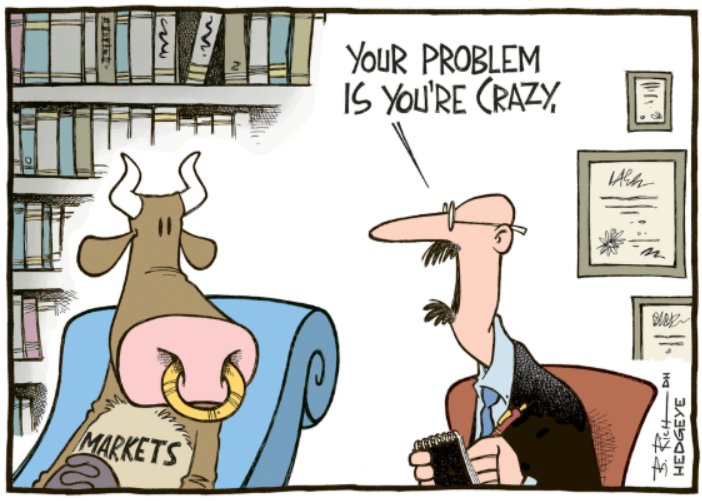
The markets last Friday went crazy on the intimation by Powell that interest rates may be reduced. If Donald gets his way 150 basis points. I doubt the reduction will be anywhere close to that, perhaps 25 to 50 basis points. If the economy is strengthening as they say it is, then why reduce rates, which will fuel inflation? It will also prop up flailing property prices and work in favor of gold.
What are they up to?
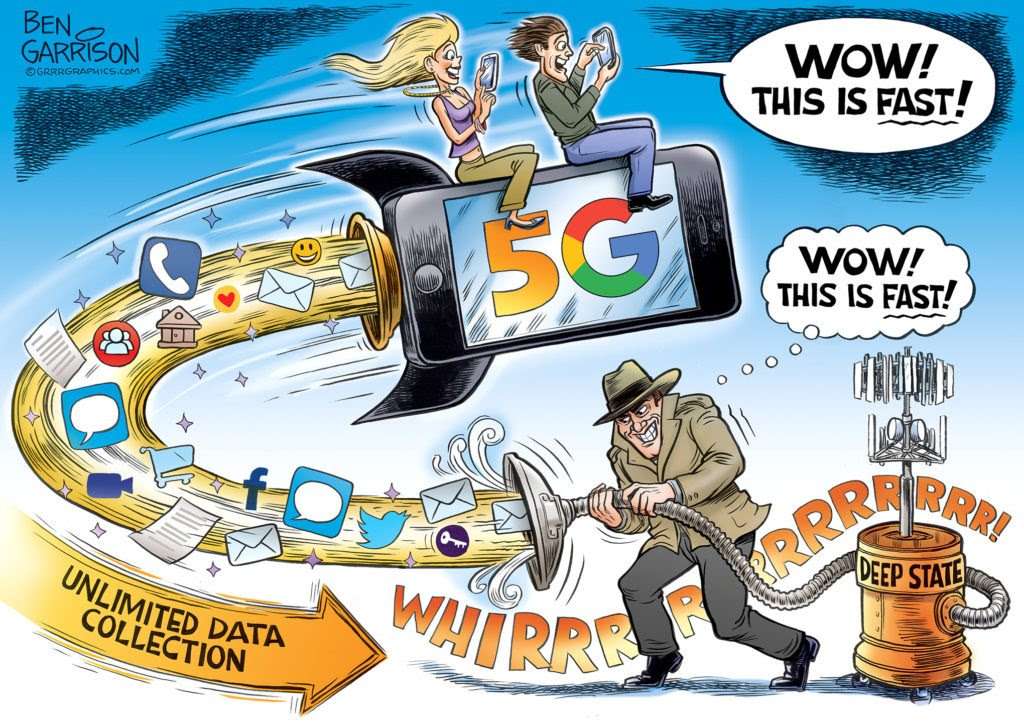
GOVERNMENT BUYS STAKE IN INTEL. Another worrisome action. I thought capitalism, which is the system we are continuously told we operate under, allows companies to make it if they can. Since when does a capitalist state own private enterprise?
News Tuesday: Pentagon contemplates buying stakes in defense contractors!! It gets more ominous.
When a government buys or takes a large ownership stake in public companies, it can have major economic, political, and social consequences. The impact depends on how it’s done. Directly buying sufficient shares to have board representation I would say is counterproductive. Buying shares at all I would say is wrong.
Here is what I think of about the government buying public companies:
- Market distortion: Government ownership can reduce competition, leading to inefficiency and slower innovation.
- Misallocation of resources: Decisions may be guided by political priorities (e.g., protecting jobs in a voting region) rather than efficiency or profitability.
- Reduced investor confidence: Private investors may fear expropriation or government favoritism, leading to lower investment and capital flight. Not what happened with Intel.
- Moral hazard: If firms expect bailouts, they may take excessive risks, knowing losses will be socialized.
2. Political Risks
- Cronyism and corruption: State-owned firms are vulnerable to being used as tools for rewarding allies or securing political influence.
- Reduced accountability: Governments may shield poorly performing firms from scrutiny, leading to long-term underperformance.
- Policy capture: Large state-owned enterprises can influence political priorities, turning into “too big to fail” political instruments.
3. Social Risks
- Taxpayer burden: Bailouts or acquisitions use public funds, meaning losses are effectively paid by taxpayers.
- Inequality concerns: If nationalized companies serve special interests (unions, executives, or elites), the general public may bear costs without seeing benefits.
- Reduced innovation and productivity: With less competition, industries may stagnate, hurting long-term consumer welfare.
4. Global/Strategic Risks
- Trade tensions: If governments acquire companies in strategic sectors (energy, tech, defense), foreign governments may retaliate with tariffs or restrictions. (Local companies not in the government pocket will be prejudiced).
- Capital market shrinkage: A large state role in equities can crowd out private ownership, shrinking public markets and reducing transparency.
- Geopolitical leverage: State-controlled companies may be used for political aims abroad (e.g., pricing energy to influence other nations).
5. Historical Examples
- USSR / Eastern Bloc: State control of most enterprises led to inefficiency, shortages, and eventual collapse.
- Venezuela (oil nationalization): Short-term populist gains but long-term economic decline due to mismanagement.
- 2008 Financial Crisis (partial bailouts): The US and UK governments bought stakes in banks. In some cases (e.g., Citigroup, RBS), taxpayers took large losses; in others (e.g., Goldman Sachs), governments later profited, but confidence in private-sector independence was shaken.
- China: State-owned enterprises dominate many sectors, often with inefficiencies but used as levers of state power.
In short: Government buying public companies can stabilize crises or secure strategic industries, but overuse risks inefficiency, corruption, loss of competition, taxpayer losses, and political abuse.
In my opinion that is what chapter 11 is for. Non government intervention in order to salvage what they can for creditors or to save the business.
We are being corralled into the net of total control and total personal transparency while governments want the reverse for themselves.
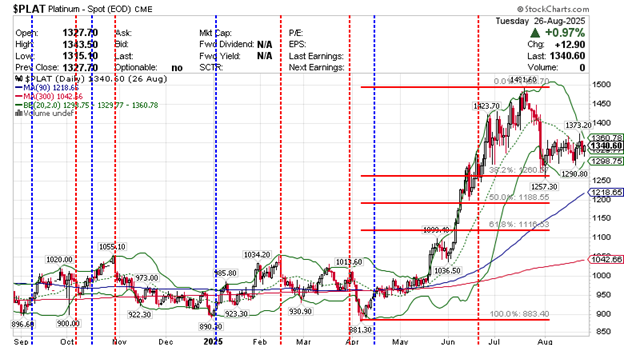
PLATINUM
SELL: (20 June 2025). PLAT touched the Fibonacci retracement. It is bouncing off it. No buy signal yet.
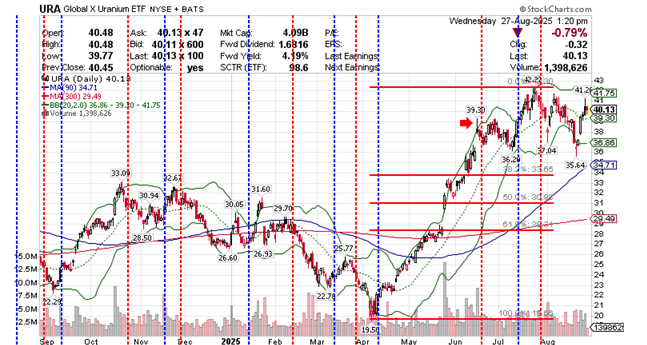
URANIUM
SELL: (30 July 2025) URA. No buy signal yet. I worry about a buy here as uranium is getting to an overbought level and has produced a shooting star which is a sell signal.
BITCOIN AND GOLD
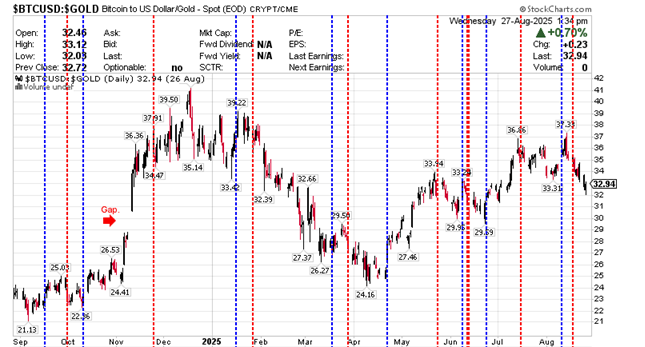
BUY Gold versus Bitcoin (19 August 2025). Gold outperforms Bitcoin.
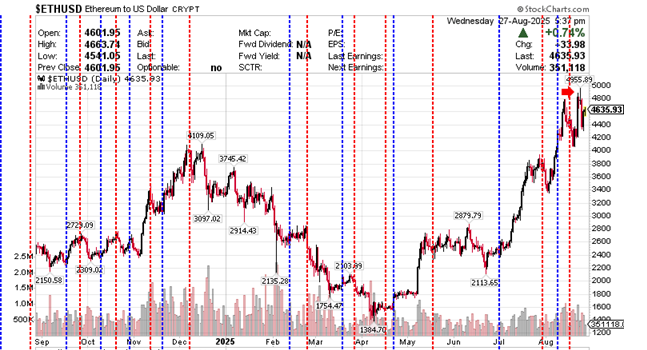
ETHUSD: SELL: (18 August 2025). Indicators not supporting a buy yet.
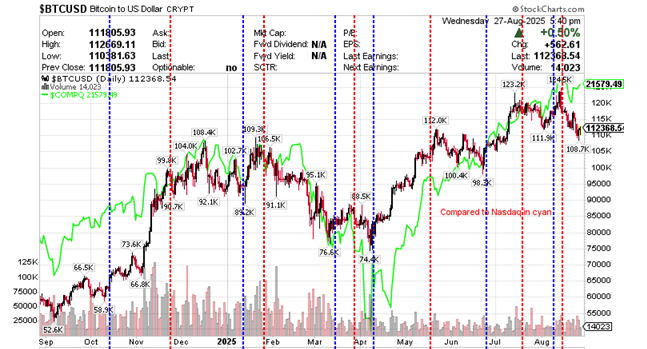
BTCUSD: SELL: 15 August 2025. NASDAQ (Cyan). No buy signals yet. There is, however, a divergence from the Nasdaq plot.
GOLD AND SILVER STOCKS
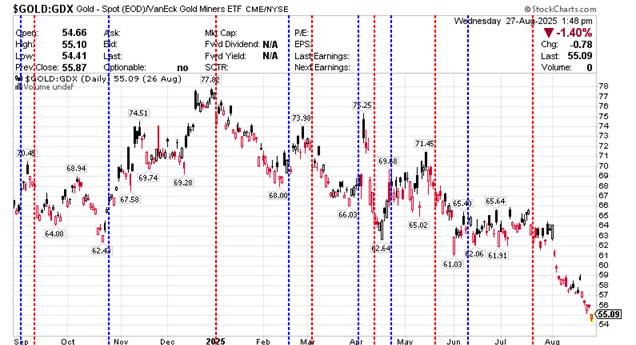
Gold stocks outperforming gold (23 July 2025). Gold stocks outperform gold. Looking oversold, turning.
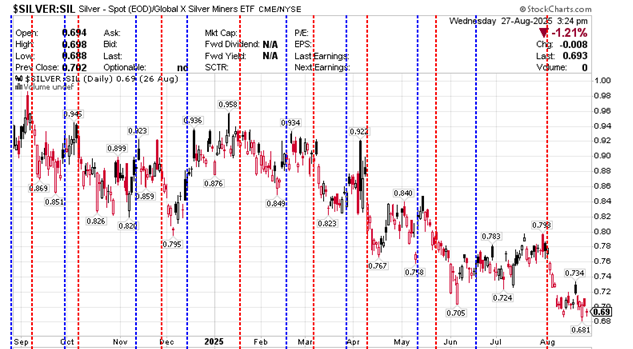
Silver stocks outperform silver (1 August2025). Looking oversold, turning.
GOLD AND SILVER
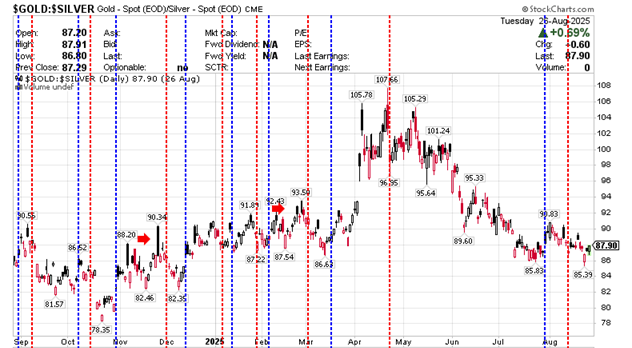
Silver to Gold Ratio
Silver outperforming Gold. (Signal given 13 August 2025) When we think that silver is coming out of the ground at about 8:1 and the Gold:Silver ratio is 87.90, something is way out of kilter.Silver is an astounding buy at this time or gold is in for an extremely heavy correction.
GOLD TO USD
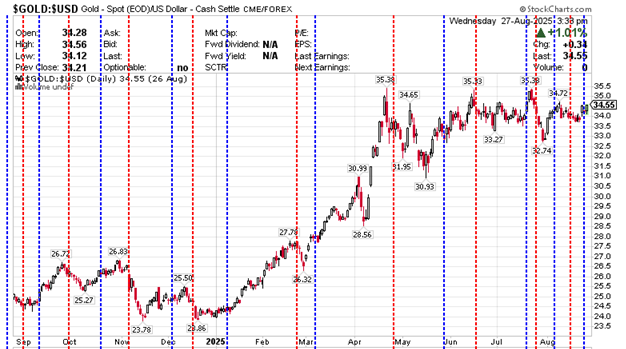
Gold outperforms USD, (25 August 2025).
A LOOK AT THE GOLD AND SILVER CHARTS
| Today | Last Week | |
|---|---|---|
| Gold Price | $3,401.00 | $3,341.00 |
| Silver Price | $38.97 | $37.90 |
| Gold:Silver ratio | 87.05:1 | 88.09:1 |
| Gold Miners bullish percent index I have seen 100 previously and see this as a sign to close out or look for short gold trades. On the other hand gold volatility is trading near lows around 15.00 which is usually a great time to enter gold trades. This can hold for many more weeks. | 100.00 | 100.00 |
| Dollar Index | 97.86 | 98.25 |
| Dow:Gold Ratio (BahaUS 45,639.00 Gold price, $3,401.00) | 13.42 | 13.39 |
| Current USA inflation rate (Dept. of Statistics) | 2.7% | 2.7% |
Gold’s low of the week was $3,351.00, and the high was $3,408.00, now trading at around $3,400.00.
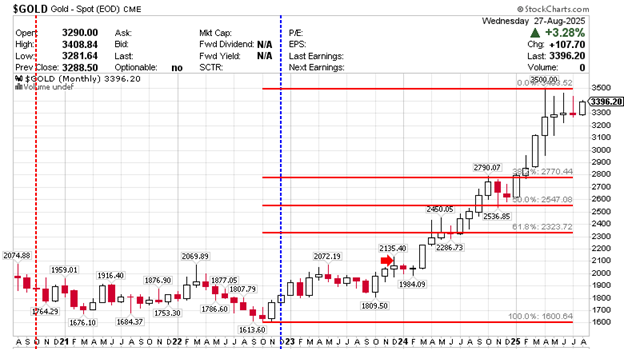
- Gold Monthly: is a hold. We bought in at $1,800.00 in October 2023. Looking overbought, but it can hold that situation for a while. No sell signal yet. (Chart below).
- Gold Weekly: (SELL 12 May 2025) The sell indicators were very early, but I see no signs of recovery at this point. We have mixed signals. The indicators are still negative. The weekly price is moving sideways with a small upward bias.
- Gold Daily: (BUY 25 August 2025).
The low for Silver this week was $38.08 and the high $39.11 trading around $39.02 at present.
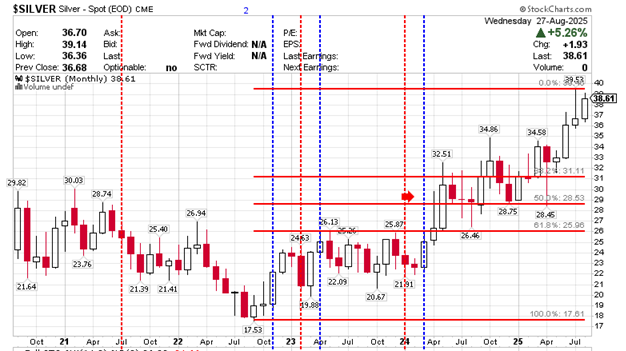
- Silver Monthly: Hold. (Buy: $24.00 March 2024). Looking overbought but positive flows of cash into the metal. ( Chart below).
- Silver Weekly: (SELL 28 July 2025). Spike is still high, not eclipsed. Indicators turning up. Rate of change is still negative but turning up.
- Silver Daily: BUY (25 August 2025).
Our partner has stock of both gold, silver and Goldbacks in our vaults available in Panama. Please contact us for more information.


A video by Mike Adams on the Goldbacks.
Well worth a look!
On the Stockcharts.com charts, the blue vertical lines are our proprietary system buy signals and the red vertical lines are system sell signals – for information purposes only
An interview with Josh, owner of Scottsdale Mint:
Please contact us to arrange the purchase and storage of your gold and silver requirements in a safe, insured location outside of your jurisdiction.
If you are interested in an overview of Fort Kobbe, you may want to have a look at this video: Mike Brown, Director, Fort Kobbe, International Vaults, A DotCom Magazine Exclusive Interview
This is my interpretation of the market and is not to be taken as financial advice. Before making any buy or sell decisions I recommend that you consult with your professional financial advisor.


RECENT COMMENTS